In March 2026, the Shaoyang branch of Hunan Bank published a procurement notice: it wanted to buy one year of advertising on the LED screen at Shaodong high-speed railway station plaza. That same month, China Merchants Bank's Zhengzhou branch launched a supplier search for LED ads at Zhengzhou East Station's north and south drop-off platforms. The Postal Savings Bank went further — its Zhengzhou branch tender specified at least 8 LED screens inside and around the station, each no smaller than 2 square meters, playing no fewer than 480 times per day.
Three banks. Three cities. One move: buying LED screens at railway stations.
The 2026 High-Speed Rail Advertising Industry White Paper groups "financial services, insurance, and business consulting" into a single ad category. Its strategy summary is four words: premium placements, long-term occupation. When financial brands spend money at railway stations, they're not playing the same game as FMCG or auto brands. They're not chasing "more eyeballs." They want "the right people, in a credible place, seeing it repeatedly."
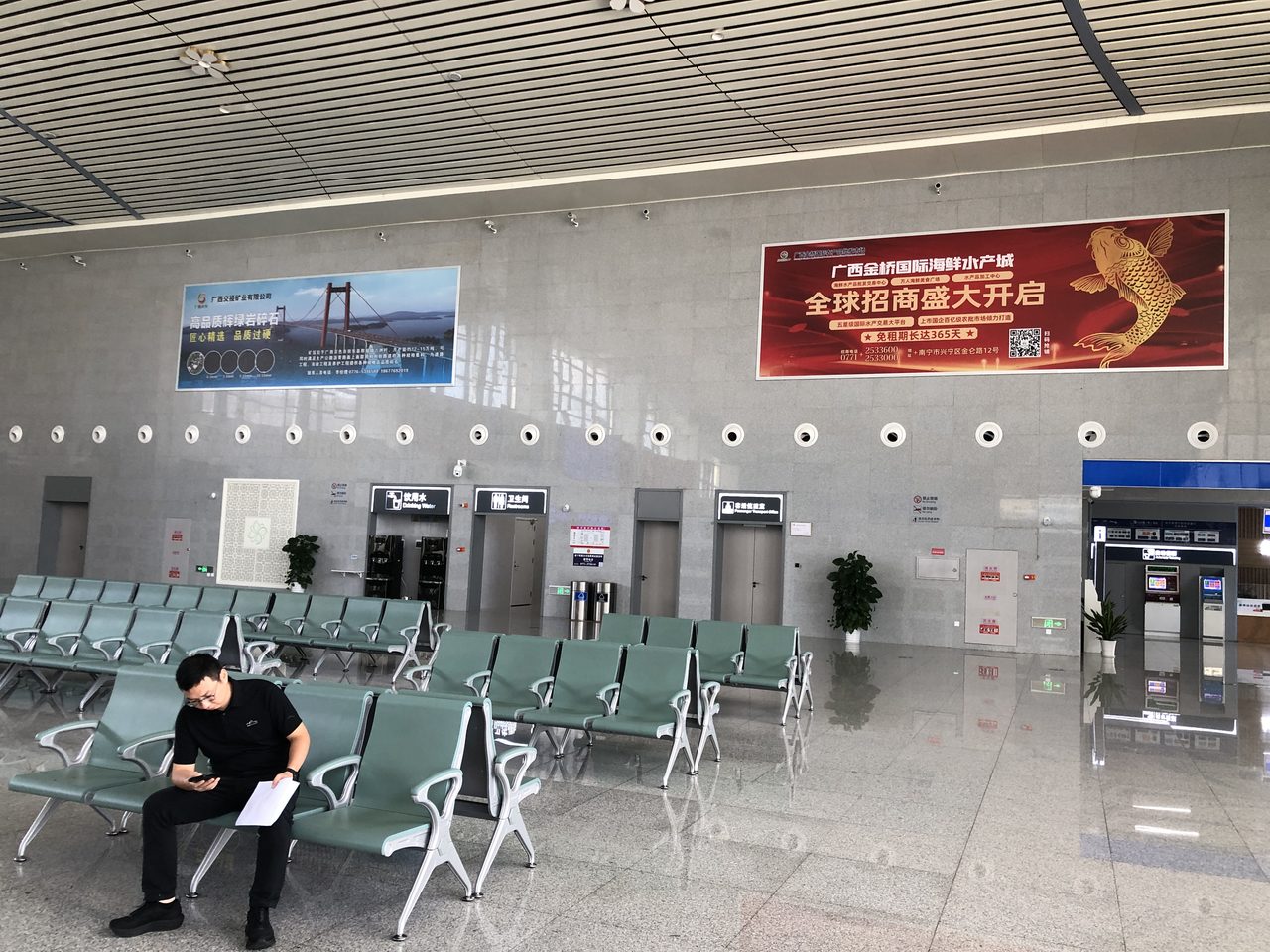
Brands already running on Yulin North Station's waiting hall walls. Financial institutions want exactly this kind of "infrastructure-grade" exposure.
1. Banks Don't Spend Blindly — They've Run the Numbers
Start with cost. The CPM (cost per thousand impressions) for a station LED screen runs around 1.19 yuan. Douyin's in-feed CPM is 10 to 15 yuan. Elevator ads run about 15 yuan. Getting your brand in front of 1,000 people costs less than one-tenth online of what it costs at a station.
Now look at the audience. About 45% of HSR travelers are business commuters. Over 70% hold a bachelor's degree or higher. These aren't casual scrollers killing time on short video apps. They're decision-makers traveling for meetings, site visits, and industry conferences. Wealth management products, corporate loans, premium credit cards — the target customer for these products maps almost perfectly onto the railway station demographic.
Third-party monitoring shows that financial brands can achieve an ROI of up to 220% at core hub stations. The Agricultural Bank of China once won a bid for four train sets over six months at 1.315 million yuan — that works out to under 7,300 yuan per day to reach business travelers along an entire line.
The math isn't complicated. What's harder to grasp is why banks don't just spend everything online.
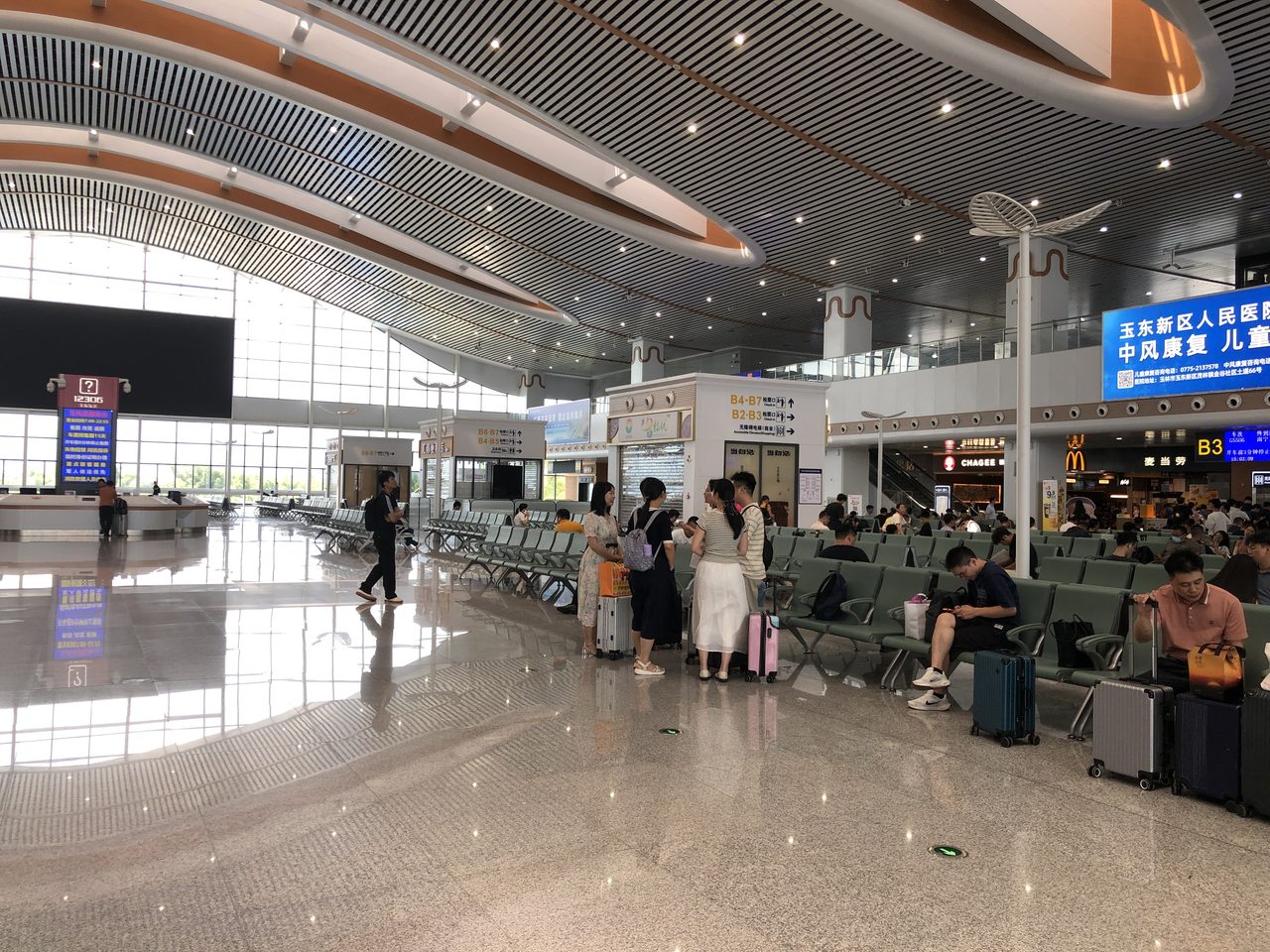
Daily foot traffic at Yulin North Station. Business travelers make up a large share — precisely who financial institutions want to reach.
2. "Trust Environment" Is Something Money Can't Buy Online
Banking and insurance products share a trait: customers don't buy a wealth management plan or sign an insurance policy because of one in-feed ad. These products require prior trust — you need to believe the institution is legitimate before you'll consider what it sells.
The problem with online advertising is the distance it creates between brand and user. A screen, an algorithm, a feed full of competitor messages. Users know it's "advertising" — someone paid to shove it in front of them.
A railway station is different. An LED mounted on the waiting hall wall sits next to national railway security checkpoints, ticket gates, and official departure boards. Travelers subconsciously associate whatever appears on that screen with words like "legitimate," "official," "reliable." That trust premium is something no online channel can replicate.
So when financial brands advertise at railway stations, they aren't buying impressions. They're buying a trust environment. It signals to every passing traveler: this institution has the scale and credibility to appear at a national transport hub. It isn't some fly-by-night operation.
3. The Opening for Guangxi's Local Banks
National banks (ICBC, ABC, BOC, CCB, BoCom) have long locked down the LEDs at Beijing South, Shanghai Hongqiao, and Guangzhou South. But Guangxi's local institutions — Guilin Bank, Beibu Gulf Bank, Liuzhou Bank, regional rural commercial banks — have almost zero presence along the Nanyu Railway line.
Yulin North Station currently sees 5,000 to 6,000 passengers daily. Modest by national standards, but more than enough for a city-level bank. Guilin Bank operates over 300 branches across Guangxi; its customer base overlaps heavily with Nanyu Railway traffic: business owners commuting between Nanning and Yulin, civil servants, middle-class families visiting hometowns.
Booking an LED or light box at Yulin North right now means paying "dead-end station" rates. Once the Yucun section opens late this year, daily volume could triple to 15,000–20,000. Ad placement prices will likely rise — but clients who signed early contracts won't be affected.
It's like buying property before the neighborhood gets developed. Except here you pay monthly rent instead of a down payment.
4. Three Practical Tips for Financial Brands at Railway Stations
Tip
What to Do
Why
Pick LED screens or waiting-hall light boxes
Avoid noisy entrance halls; prefer quiet light boxes in waiting areas or business-class zone LEDs
Financial brands need a calm atmosphere — don't sandwich yourself between bubble tea ads
Commit ≥6 months
6+ months gets roughly 25% off list price; AgBank's 1.315M/4 trains/6-month deal used long-cycle discounting
Trust takes time to build. A one-month buy is basically invisible
Don't shout returns in copy
Lead with brand strength + compliance + exclusive service; never write "annualized X%" or "guaranteed profit"
The Advertising Law prohibits it, and yield-screaming ads look desperate anyway
Combine all three Nanyu stations
Yulin North for regional authority + Xingye South for B2B visitors + Hengzhou for cross-city flow
Three lines reach different audiences; total budget stays controllable
5. Bottom Line
Banks and insurance companies advertise at railway stations not because they have money burning holes in their pockets. It's because they've figured out three things: the audience fits, the CPM is low, and the scene builds a kind of trust that online channels simply cannot deliver.
For Guangxi's local financial institutions, ad slots along the Nanyu Railway sit in a "price valley" right now. National giants haven't yet bothered to expand into these second-tier markets. Once the Yucun section opens and the Guangdong segment connects, the best spots will get snapped up.
The window won't stay open forever. Whoever stakes a claim first gets a permanent seat on this corridor into the Greater Bay Area.
— Lianping Media, Exclusive Ad Operator for Nanzhu Railway Nanyu Section | Li Hongxin 18878774848 (WeChat)