How many people pass through Yulin North Station each day right now? 5,000 to 6,000. That looks thin under the sign of "Guangxi's third-largest high-speed railway station." But the root cause is simple: it only connects to Nanning East. It's a dead-end line. Want to reach Guangzhou or Shenzhen? Transfer in Nanning first.
The turn is close. The Yulin North–Cenxi East section finished track laying in 2026, with an 84.4% bridge-and-tunnel ratio, and opens by year end. Guangdong's side moves in parallel. The full line links into the national network at Fozhao in 2027. From then, Yulin North reaches Guangzhou, Shenzhen, and Zhuhai directly: 48 minutes Nanning–Yulin, about 2 hours Yulin–Guangzhou, 2.5 hours to Shenzhen. The whole southeast Guangxi falls inside the Greater Bay Area's two-hour circle.
On opening day, daily ridership jumps from today's five or six thousand to 15,000–20,000. This is a public forecast, not our guess. Yulin's registered population is 7.44 million, Guangxi's second largest, with the region's highest birth rate. If it holds this number as a dead end, once the line opens, people from Beiliu, Rongxian, Bobai, and Luchuan will all converge here.
LED screen at Yulin North Station. Slot prices sit low before opening; the post-opening ridership jump lands directly on the rate card.
1. The One Question Advertisers Must Answer: When to Enter
Enter now, and you buy the price low. The three stations (Yulin North, Xingye South, Hengzhou) are packaged together at a base tender price of 700,000 yuan per year, on a six-year lease. The inventory: 97 light boxes (1,539.85 sqm total), one full-color LED screen (152.52 sqm, Absen P2.5), and 14 dual-sided 4K ad machines. Facilities are built. Hang the creative and it runs. That price reflects "five or six thousand riders a day." After the 2027 opening, ridership triples or more. Rate cards go up. No hub keeps the old price after that.
Exit passage ad space. Travelers slow down and attention returns here, making it one of the highest-conversion spots to place a live campaign.
2. Early Entrants Get Two Discounts at Once
Today's low rate, and the natural traffic after opening. Your creative hangs on the wall and does nothing; the crowd doubles on its own. Late entrants pay more for the same wall.
Some can't do the math: ridership is low now, isn't it a waste? Look at it this way: a light box costs a few thousand to ten-odd thousand a month. You're buying the whole two-year ridership climb. Wait until the station is packed, then fight for space: higher price, good spots gone. Locking a slot early is the same logic as buying shopfronts along a subway line before it opens.
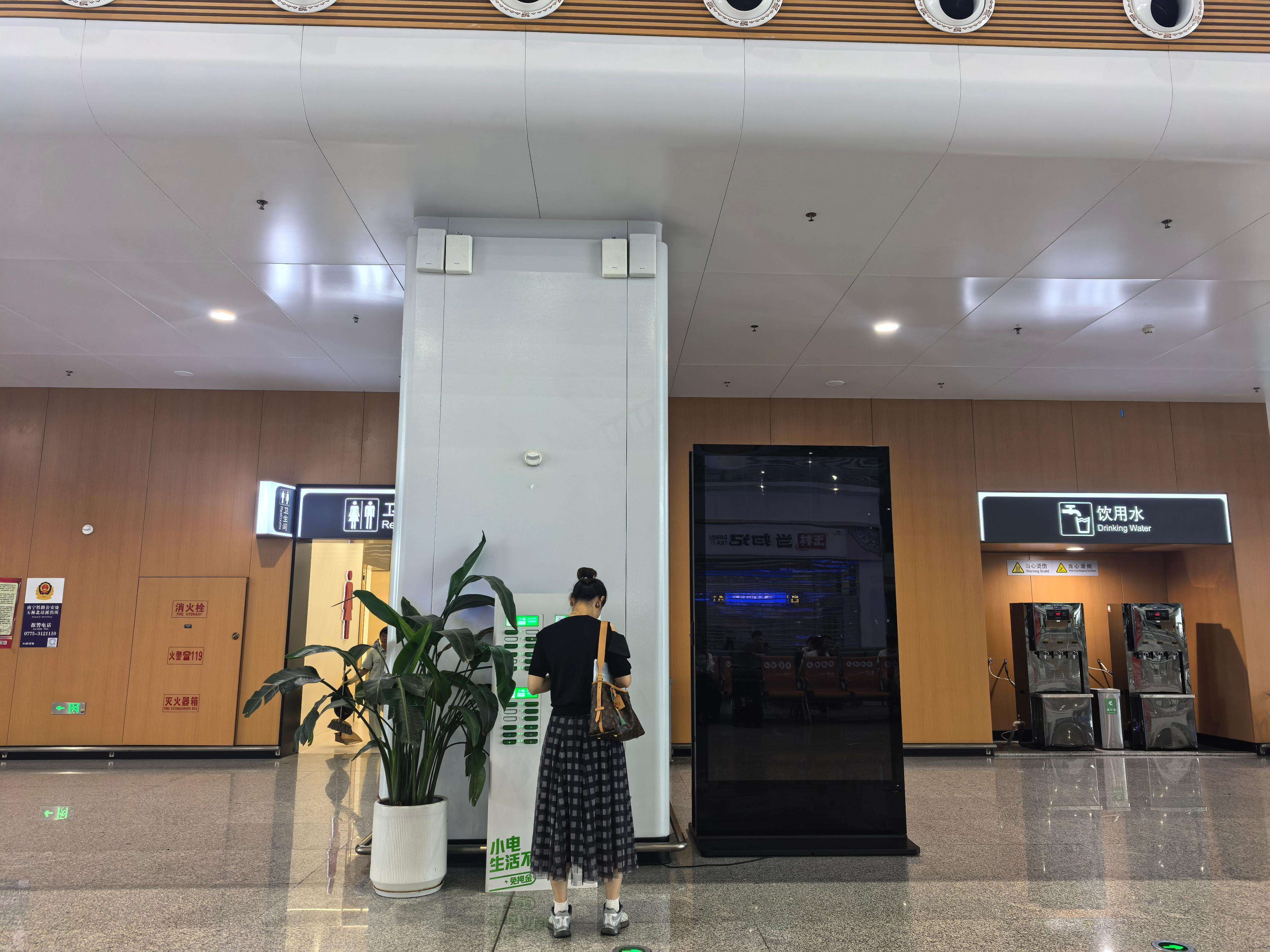
Digital screen array in the waiting hall. Multi-screen rotation carries different messages, good for brand warm-up before a new line opens.
3. Why Now Is the Low
The base tender price is set on current ridership. The railway operator prices on present foot traffic, not on "future opening." When it really opens, the operator revalues the inventory and adjusts the rate card. That gap in time is the cheap a brand can pick up.
One more layer. Yulin North is the core node of the Nanning–Shenzhen high-speed line, built to top spec with four platforms and nine lines fully reserved. Right now capacity is throttled by the incomplete line, it's holding back, not maxing out. Once Guangdong's section opens, it shifts from "dead-end station" to "southeast Guangxi's gate to the Greater Bay Area." A brand's exposure scene grows from local business travelers to cross-city business, returnees, and tourists. The name you hung during the dead-end period gets seen by a far wider crowd after opening.
Xingye South and Hengzhou follow the same logic. Smaller, quieter now, but both sit on the Nanyu line and wake up with Yulin North after opening. Small-station slots are cheap and fit precise county-level reach. Local brands on a tight budget can take them first.
4. Who Should Move Now
Guangxi-local chains, home furnishing, automotive, agricultural specialties, recruiting and training. These brands target exactly the people of Yulin and its counties. Occupy now, build awareness cheaply. After opening, competitors flood in, and slots and inventory tighten.
How to combine the three media types? Light boxes hold steady exposure, good for the brand name and main visual long term. LED and screens carry motion, good for rotating products and campaigns. Tight budget, take light-box slots first, add screens for a burst before opening. Our plans usually put 70% of budget on light boxes, 30% on screens for peak moments: presence daily, voice at peaks.
A few concrete scenes. A home-furnishing brand rotates new products on screens, and hangs a "stop by the store on your way out" prompt on the exit light box, pulling station traffic to the shop. An agri-gift brand uses the waiting-hall light box for the gift-box visual with a QR coupon; returnees carry it home as a gift, repeat buys come from this crowd. Same logic for autos: rotate models on screens plus a logo light box at entry, showroom test-drive conversion beats local radio. Small slots, big math.
Don't expect to grab a slot the week it opens, either. Station ad production needs review and printing, normally one to two weeks. By the time the opening makes the news and you call, the good spots are already booked by people who planned ahead; what's left is expensive or off-position. The window period is for turning uncertainty into your fixed cost in advance.
At the bottom, the pre-opening math is simple: pay today's low rate for the whole two-year ridership climb. Wait until the station is packed and the good slots are gone. Window open, first come first served.
— Lianping Media, Exclusive Ad Operator for Nanzhu Railway Nanyu Section | Li Hongxin 18878774848 (WeChat)