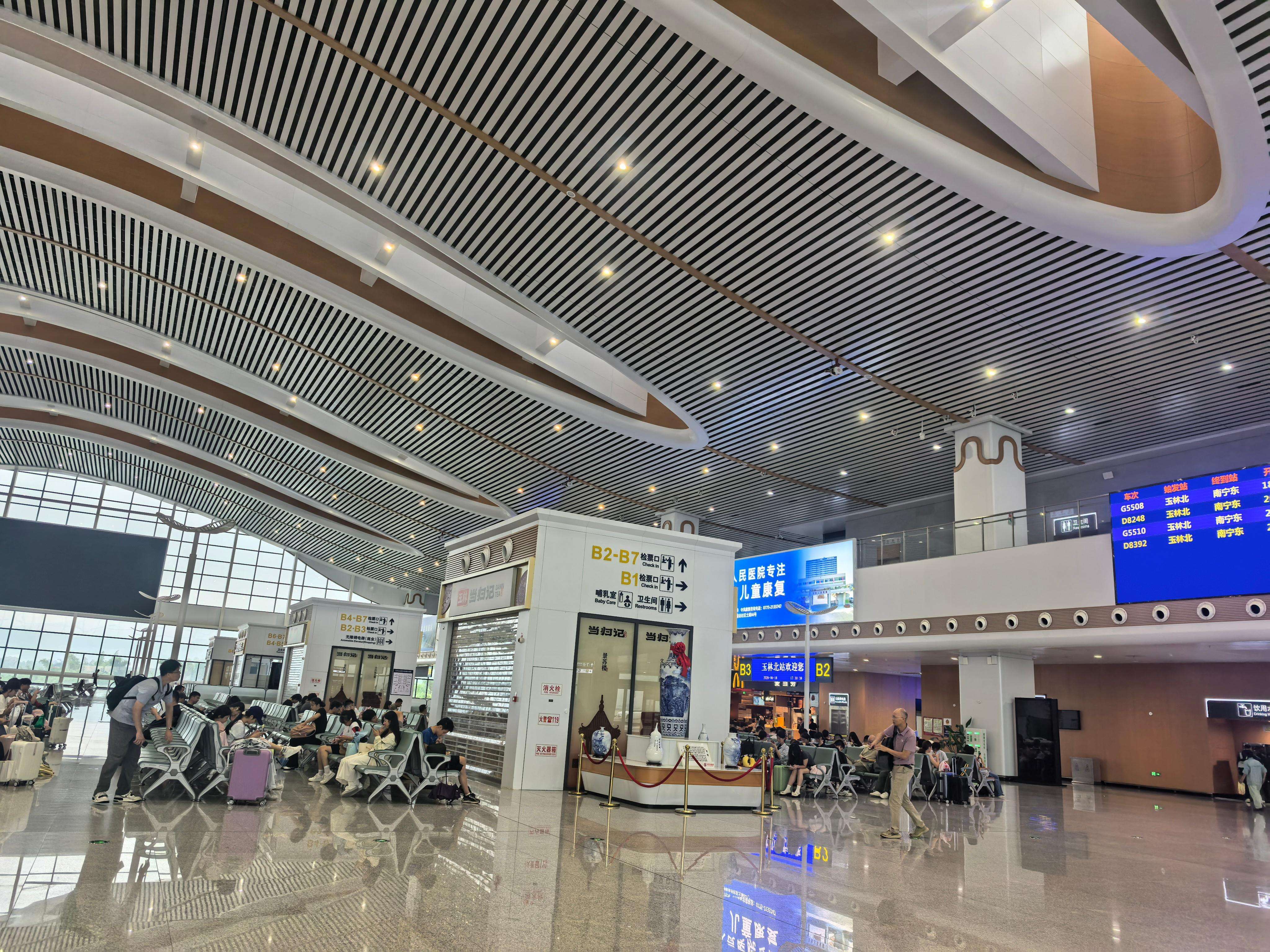
The Nanyu line ran one year and moved 2.75 million riders. Twenty trains a day, Yulin North now 5,000–6,000 daily. That many people walk through the station. Does an ad on the wall turn into an order? We'll skip the fluff and show the chain.
1. Reach First, That's the Floor
A station is a half-closed space. Entry, security, waiting, gate, exit, riders can't avoid the ad slots. Public industry data puts LCD screen reach at 92.4%, digital screens at 85.4%. Of a hundred people entering, ninety-two see that screen. Street boards don't hit that. Elevator ads don't either.
Dwell time helps. Riders wait 30–90 minutes average, look up from the phone, there's the screen. That idle stretch is the best window for ads. In one Taigu West case, a drink brand ran a summer cooling theme and its scan-to-convert rate beat ordinary business districts by 2.3x.
Digital screens in Yulin North's waiting hall. Hundreds of plays a day, the high-frequency spot for action prompts and QR codes.
2. Frequency Beats One-Shot Exposure
Riders meet station ads 4.2 times a week on average. Ad people talk about a "7-times memory threshold": repeat a message seven times and it sticks. Screens rotate hundreds of times a day, light boxes hang all day; one person gets hit three or four times from entry to exit, crosses the threshold in days.
That's why brands stay long. Glead tiles ran 21 cities, 25 stations in August 2026, a million touches a day. Deeyeo wet wipes rode a spokesperson across 10 cities, 12 stations of LED, and search and inquiries rose across Hubei. They don't test for a week; they treat the railway as a long-term base.
3. From "Seen" to "Scan," One Action Gap
Reach alone isn't enough. To move riders, the creative needs a clear instruction: QR in the corner, copy that says what scanning gets you. At Xingye South, Mingxin Tea's plaza showroom pulls over 1,200 visitors a weekend; they run a high-speed tea trip, 50 minutes from Nanning straight to the garden, and on-site sales rose 25%. A rider sees the tea-trip ad, scans, the trip is booked.
Yulin North's business crowd is more direct. An auto brand rotates models on the waiting-hall screens with a consult QR; business riders see it both ways daily, and when they want a new car they scan. The conversion doesn't wait; it lands in the showroom that week.
Light box at Yulin North. Steady all-day exposure, fits the brand name and a long-term QR that catches repeat-touch conversions.
4. Different Slots, Different Jobs
Entry passage and waiting hall are forced-view zones, good for the brand name and trust. Exit passage slows people and brings attention back, good for action prompts like "where to eat, where to buy, which code to scan." The gate queue holds 8–15 minutes, good for making one point clear.
Spread the messages across slots beats hanging the same creative everywhere. We usually tell clients: hold the name with light boxes, rotate the model or event on screens, park the action prompt (QR) at the exit.
5. Small Brands Can Play Too, Don't Fear the Price
Many think railway ads are for giants only. County stations are cheap and precise. Xingye South, Hengzhou, thin competition; one light box there may cost a fraction of a corner at Yulin North. Local supermarkets, farm gear, tea firms, recruitment, speak on those screens to their actual customers.
Data backs it. Home-furnishing brands doing local deep cultivation lifted qualified leads 29% over blind national buys, store traffic 41%. Auto brands pushing down to tier-3/4 core stations raised showroom visits 32%. Money on the right people, not the most people.
6. A Few Real Traps
Don't blind-buy national. Spread the budget, big reach but thin precise flow. Know where your crowd is first: a local brand covering the whole county takes all three stations as a package, cheaper than one pricey Yulin North screen.
Don't cram the creative with text. Ad line under 8 characters, total copy under 15, main visual over 70%, QR in the corner not stealing the show. Too much text, nobody reads.
Don't wait for the opening. The Yucen section meets opening conditions by year-end; after the 2027 full link, the crowd shifts from Nanning-bound to Greater Bay Area-bound. Brands hanging now pre-occupy space in front of future high-value crowds.
If you want to know which screen fits your product and what prompt to put, tell us your product. We'll build a mix off the three stations' ridership, free. Call 18878774848.
— Lianping Media, Exclusive Ad Operator for Nanzhu Railway Nanyu Section | Li Hongxin 18878774848 (WeChat)