Hospitals and clinics are now among the advertisers at the three rail stations Lianping runs. Medical providers are not after noise. They are after trust.
1. Hospitals do buy rail-station ads
This is not new. In 2025, Zhejiang Provincial People's Hospital's Bijie branch bought lightbox ads at Bijie high-speed rail station through a sole-source procurement. The public notice said it plainly: expand the reach and name recognition of a national regional medical center, and clarify the route patients take to the hospital. A top-tier hospital going through procurement for a station lightbox wants one thing — local people see it on their way in and out.
An organization in Harbin measured this. After medical-health firms advertised at the rail station, in-store consultations rose about 12% on average. The number comes from a third party, not from us. Medical decisions take time; you make them remember your name first, and they think of you when they actually need care.
2. Why the station, not social feeds
Medicine lives or dies on trust. The rail station is clean, bright, orderly — a backdrop that lends an ad an air of credibility. Travelers wait over 30 minutes in the hall, often with patchy phone signal, which gives the ad a quiet moment to be read.
The screens roll hundreds of times a day, drilling "this specialist" or "this check-up center" into heads more precisely than a social feed — the people on the train are local residents with spending power, not strangers passing by.
Yulin itself has Ciming Check-up (under Meinian One, with a 5,000+ sqm clinic in the city) and Century Health, professional check-up operators. To grow, they rely not on flyers but on getting Yulin residents to recognize the name first.
3. Three stations, three kinds of patients
Yulin North is still a stub station, five to six thousand a day, but heavy with business and returning travelers — good for high-ticket specialists and check-ups. Xingye South sits among communities and towns within three kilometers; community care, chronic-disease management, dentistry fit there. Hengzhou draws tea merchants; check-ups and traditional medicine catch that crowd.
| Station | Main crowd | Best for |
|---|
| Yulin North | Business, returnees | Specialists, check-ups |
| Xingye South | Community, township | Community care, chronic, dental |
| Hengzhou | Tea merchants | Check-ups, TCM wellness |
Placement matters. The lightbox opposite the exit meets returnees dragging suitcases the moment they step out — good for check-up centers and specialists to collect leads. The hall screens repeat the reminder and wear the name in.
4. Do not write the ad like a manual
Medical ads most often fail by cramming in every department and machine. Rail authorities review medical ads strictly; exaggerated claims and absolute terms are rejected. What you can show: credentials, expert teams, the institution's name, at most a non-crossing line like "screen early, worry less."
Put the QR code in a corner to link to booking or navigation; keep it under 5% of the frame. Wrong placement or wrong copy wastes the budget.
5. The medicine expo already proved the sector likes exposure
The 15th Yulin Traditional Chinese Medicine Expo in 2025 filled 70,000 sqm with over 100 exhibitors, including 18 medical institutions, plus AI-assisted diagnosis demos and famous-doctor free clinics. The medical circle already fights for exposure — just not usually at the rail station.
The Nan-Yu line carried 2.75 million passengers in its first year; Yulin North now runs five to six thousand a day, over 50,000 on peak Spring Festival days. When the Yu-Cen section opens by end of 2026 and the full line in 2027, Yulin North climbs to 10-20k daily. Pre-opening is still a price low; lock a spot now and it is cheaper than next year's crowd.
—— Guangxi Lianping Media, exclusive operator of Nan-Zhu Nan-Yu rail advertising (Yulin North, Xingye South, Hengzhou) | Li Hongxin 18878774848 (WeChat same)
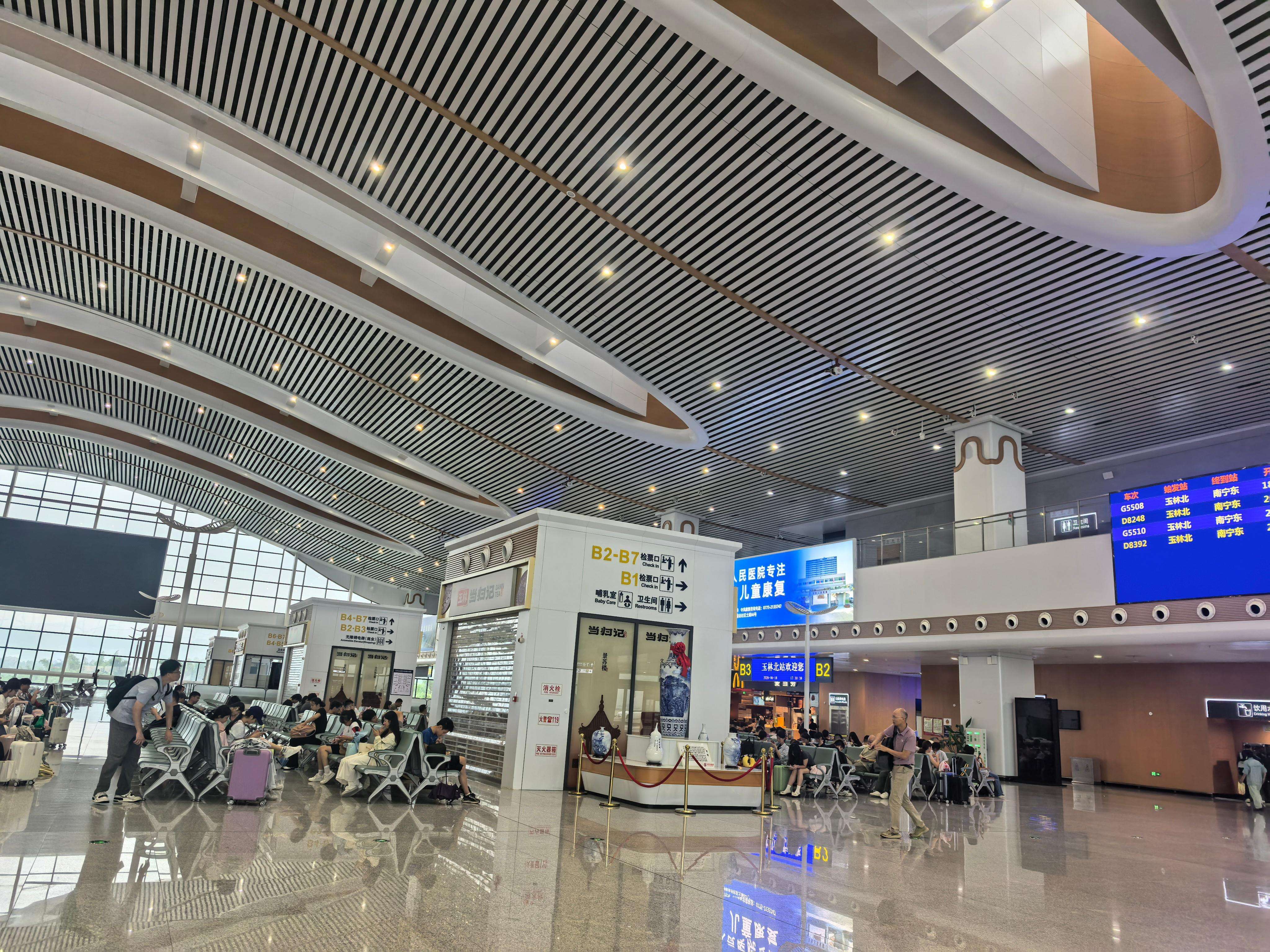 ▲ 玉林北站灯箱——医疗品牌要的正是这种“国家基础设施级”的靠谱感,不靠花哨
 ▲ 玉林北站刷屏机——一天滚几百遍,把机构名反复磨进返乡客脑子里