You think a lightbox ad is done once it's up? Your rail ad can run another free lap on WeChat Moments.
A building-materials friend booked an exit-corridor lightbox at Yulin North at the end of 2025. Two months in, the direct inquiry calls fit on one hand. He felt he'd lost the money.
Then he scrolled WeChat Moments and found a Yulin contractor had photographed his station board — that lightbox — posting "this brand finally made it into Yulin." Below, seven or eight comments asked about price and store location.
That lightbox cost 30,000 yuan. That Moments post was free. The potential clients in those seven or eight comments were free too.
This is rail-ad "secondary spread" — your ad gets photographed, sent out, and runs another lap across social networks. That lap is often worth more than the lightbox itself.
Why do rail-station ads get photographed so easily?
Three reasons, none complicated.
People waiting are bored. Over 30 minutes of wait time, the phone is the only companion. Eyes scroll, the lens hunts — a good-looking lightbox, a witty creative, that's material. Yulin North's waiting hall averages over 30 minutes of dwell, with business travelers over 80% — a group with decent information sensitivity and a fair willingness to shoot and share.
The rail station carries a "scene tag." A photo in the office is nothing. A photo at Yulin North carries "on a trip," "going home," "on the road." When a brand ad appears in that scene, it rides that story's edge. Travelers post to Moments not to share your ad — to share "being on the road." Your ad just happens to be in the frame.
Third reason, simplest: young people today want to post everything. UGC — user-generated content — is already the biggest content source on social platforms. A brand spending 1 million on a film may convince less than 100 real travelers shooting photos on their own. In the semi-enclosed rail environment, with long dwell and focused gaze, the impulse to pull out the phone and shoot is far higher than on the street.
The secondary-spread math is bigger than it looks
Q1 2026, 14,012 brands piled into outdoor ads, 63.969 billion yuan rate-card total. Rail-ad compound growth runs above 15%, and dynamic digital media already make up 35%–45%.
But most brands pay for "the first glance" — the one look in the waiting hall. Few think about turning that glance into the traveler's second glance on the phone, the third glance on Moments.
Simple math: one Yulin North waiting-hall lightbox, 80,000 yuan/month, thousands passing daily — that's lap one. If 1% photograph and share, each share seen by ~200 WeChat friends — lap two's reach can match lap one's.
And lap two has what lap one lacks: trust. You pay for an ad; consumers know you paid. But a friend posts "this brand made it into Yulin" — that's "third-party proof." In an age short on trust, the latter is worth far more. Rail-ad secondary spread essentially turns "bought exposure" into "trust-spread exposure."
▲ Yulin North waiting-hall screens — 14 screens, 28 faces, scattered around. Shooting and posting while waiting is a natural act; every screen is a potential social-spread node.
Four practical tricks — to make your ad run another lap on Moments
Not every rail ad is worth shooting. Some lightboxes hang a year and no phone ever comes up. The problem is the ad itself.
1. Bake a "reason to shoot" into the creative
Don't be subtle. Tell the traveler "this is worth a photo" directly.
How? Leave a "photo-friendly zone" on the lightbox or LED — a quotable line, a visual symbol, an interactive prompt. You don't need "please photograph and post to Moments" — too blunt, nobody wants to. But if the frame holds something people "want to screenshot" or "want to forward," the shooting happens naturally.
Lower the mental cost of shooting. A traveler pulling out the phone — there's a threshold: will I look weird? If the frame itself signals "being photographed is normal," the threshold drops. Yulin North's 152 sqm LED — that size makes people want to shoot. A brand puts visually strong content on the big screen; the traveler stands in front, snaps a photo, and that giant screen goes into Moments with them.
2. The frame needs "Moments feel"
What's "Moments feel"? — Shoot it and post directly, no editing, no caption struggle.
A dense, tiny-text lightbox photographs into something nobody reads. A clean, opinionated, visually punchy one photographs into a Moments post. The 2026 Rail-Ad White Paper notes dynamic content's recall runs 35% higher than static. LED and screen content, moving, gets shot more easily than lightboxes — a moving frame, as video, has more "Moments feel" than a photo.
Lay's did booths at Ningbo and Wuhu rail stations — not traditional billboards, but physical "Lay's Snack Stations" travelers walked in and photographed. Essentially they turned the brand into a "check-in device." Lightboxes and LEDs can't become booths, but the thinking can match: it's not just a billboard, it should be a scene worth recording.
3. Give the shooter a reason to interact
A QR code on the screen saying "follow our account" — low conversion. Nobody boarding a train wants to follow an account.
Try: "Test your travel personality, post the result straight to Moments" — one tap, one screenshot, shared, all within 30 seconds. The user gets a fun result; the brand rides that screenshot. That's "low-friction interaction" — no form, no follow, no download. Sharing is the finished action.
Yulin North's 14 screens rotate 150 times a day. One in a hundred who see it pulls out the phone — across full-day traffic, that's dozens of free social nodes. The three Nan-Yu stations reach 8,000+ travelers daily; even one per thousand does secondary spread, each covering 200 people — that's 1,600 free, targeted impressions.
▲ Yulin North waiting-hall lightbox — a well-designed lightbox isn't just an "info board"; it's "Moments material" in the traveler's phone.
4. Content needs resonance and a share urge
The most skipped point. The ad content itself must be "shareable" — the viewer thinks "that's exactly how I feel," "that's cool," "this brand gets me" — then they spread it.
The 2026 Outdoor-Ad White Paper has a figure: products leading with emotional value saw outdoor-ad spend jump sharply — scented candles +429%, projectors +162%. Those ads spread not for specs but because the frame carried "the ease of being alone," "the looseness of home." That emotional resonance is the motive to share.
Nan-Yu rail travelers are over 80% business. They don't lack buying power, but they're moved by "this brand said what I wanted to say." An exit-corridor lightbox with a line that hits a business traveler's mood — that photo lands in his Moments, and among his friends may be a dozen more also on the road.
Social-spread plays across the three Nan-Yu stations
Three stations, three crowds, three different "shot logics."
Station
Core crowd
Shot motive
Spread play
Yulin North
Business core (trips, government, inspection)
"Status of being on the road," "this city is changing"
LED big screen suits short-video spread: traveler shoots video in front, posts to Douyin. Screens suit "treasure-hunt" interaction: find screen X, screenshot for a prize.
Hengzhou
Jasmine-industry crowd, dealers, buyers
"Hometown pride," "I rep the origin"
Brand ads hitting the "home of jasmine" identity: locals more willing to forward. Exit-corridor lightbox is the "last look before leaving"; a frame that makes people "want one last glance" shoots at higher rate.
Xingye South
B-end merchants (calcium carbonate, health food supply chain)
"Industry signal," "worth sharing with peers"
B-end spreads not to "show life" but to "show info." If the ad makes B-end feel "another signal in the trade," they share to industry groups. Waiting-hall lightbox suits "industry-endorsement" framing.
One simple conclusion: different crowds see the same board and think completely differently. Business travelers think "this brand is worth watching"; industry buyers think "this info is worth forwarding to peers"; locals think "this is our home brand." The creative and the hook must match that crowd's real psychology, not one uniform slogan.
Don't spend 30,000 yuan to buy only "one glance"
The rail-ad math shouldn't count only "how many saw it." It should count "how many saw it, then made how many more see it."
One lightbox, 25,000 to 80,000 yuan/month. Thousands pass daily — lap one. 1% shoot and share, each seen by 200 — lap two matches lap one. If the content is spread-worthy and share rate hits 5% — lap two is five times lap one.
In 2026, online and offline traffic costs both rise. Douyin culture-tourism click cost went from 1.2 to 4.7 yuan. Rail-ad secondary spread — users shoot, post, friends watch, all on their own — marginal cost is zero. The brand isn't buying a lightbox; it's buying a "content launcher." Travelers aren't passers-by; they're free spread nodes. Those 30 wait minutes are where brand social fission begins.
Next time you see a lightbox at Yulin North — don't treat it as just a billboard. Treat it as an entrance. The board goes up; the spread is only starting.
That lap on Moments is free.
— Guangxi Lianping Media, exclusive operator of Nanzhu HSR Nan-Yu section ads | Li Hongxin 18878774848 (WeChat same number)


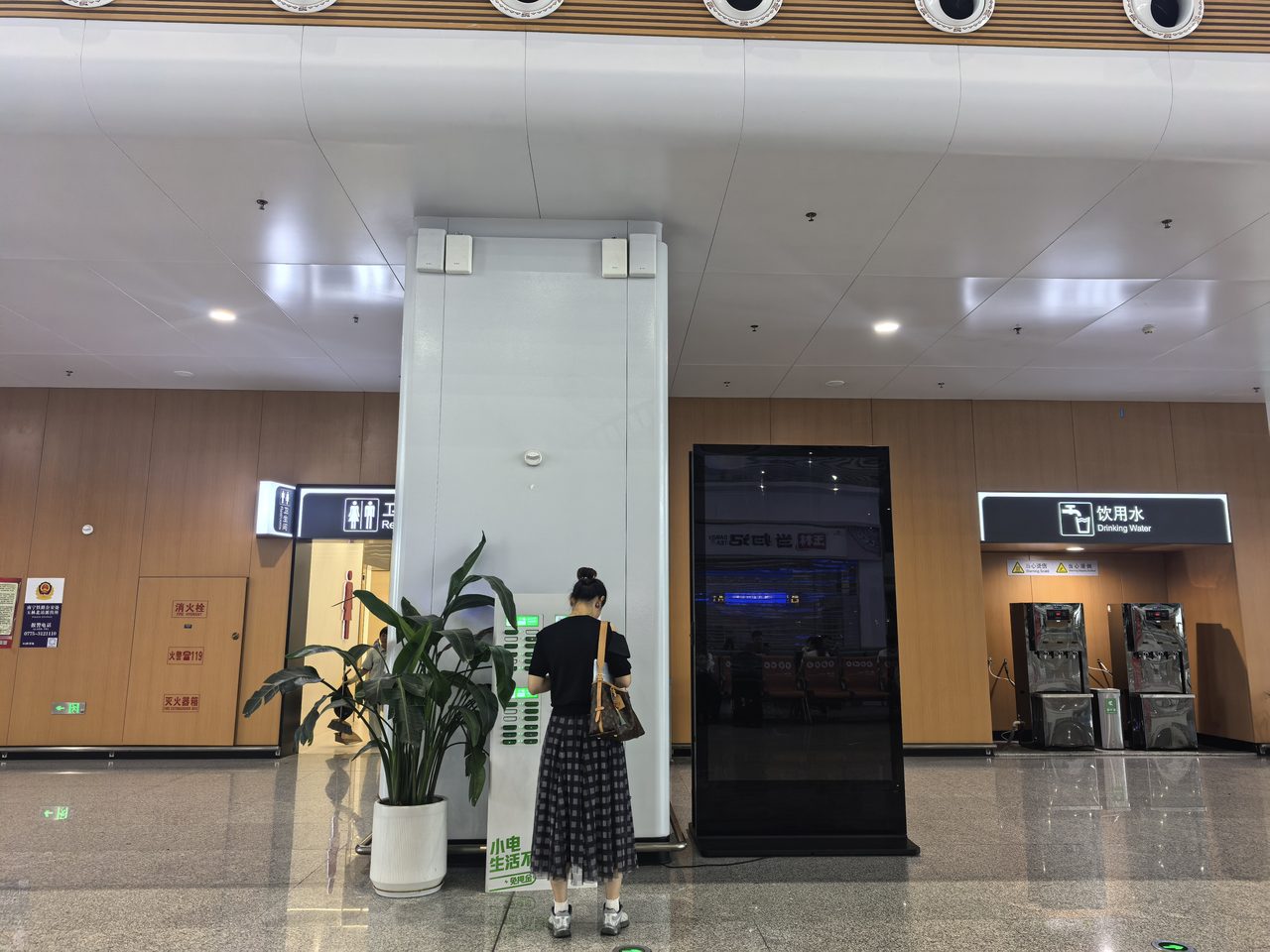 ▲ 玉林北站候车厅刷屏机,14块28面分散各处——旅客候车时刷手机拍照是天然动作,每一块刷屏机都是潜在的"社交传播节点"
 ▲ 玉林北站候车厅灯箱——一块设计得当的灯箱不只是"信息发布器",它是旅客手机里的"朋友圈素材"